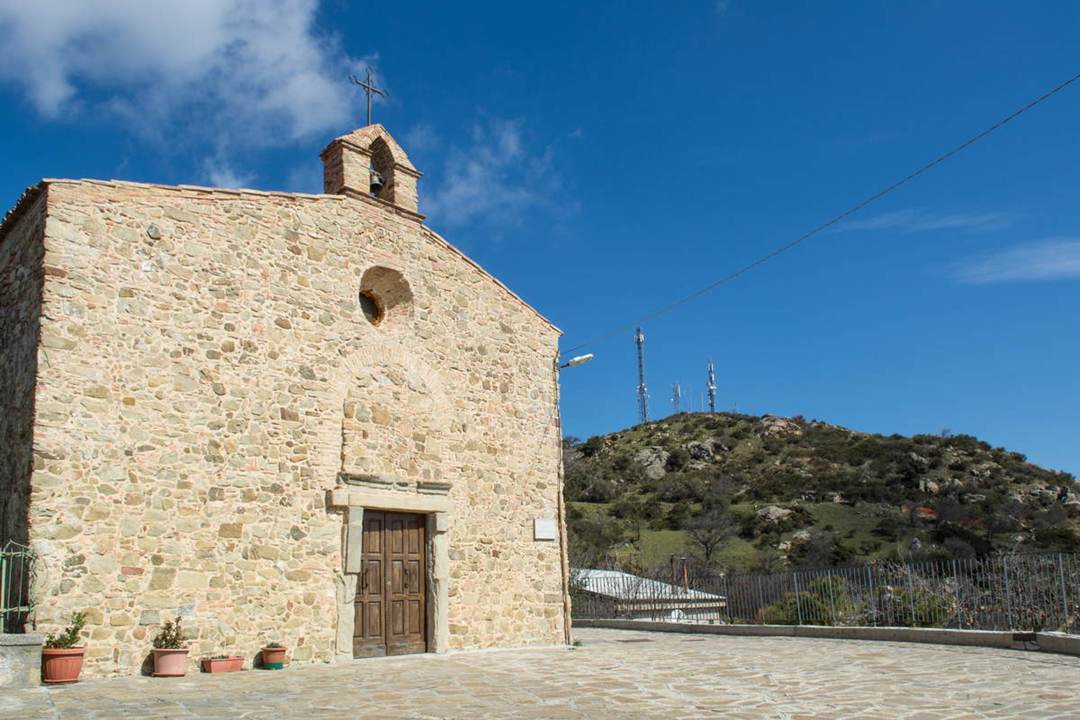
Antico Cenobio Basiliano fondato dai monaci greci bizantini intorno all’anno Mille, secondo alcuni trattasi del primo insediamento del Paese. Giova rimembrare che nelle province bizantine dell’Italia Meridionale, Calabria e Lucania in particolare, si concentrò il monachesimo greco-bizantino attorno all’anno Mille e nel secolo successivo, allorquando i Cenobi Basiliani godettero della protezione dei principi normanni. Il Cenobio di Colobraro, probabilmente non di grande importanza, dipendeva dal gruppo monastico dei santi Elia e Anastasio di Carbone, unitamente agli altri Cenobi viciniori di Noepoli, Episcopia e Cersosimo. Oggi è visibile solo la Piccola Cappella in pietra, restaurata all’indomani del terremoto dell’80, coperta a capriate lignee, mentre sulla parte posteriore della cappella si scorge il perimetro murario dell’antico cenobio basiliano di modeste dimensioni. Ai Basiliani subentrarono i Monaci Benedettini della Badia di Cava dei Tirreni e poi probabilmente i monaci cistercensi. A metà del ‘500 vi si installarono gli eremiti Colleretini, così chiamati dal luogo di provenienza Collereto (Morano Calabro), questo fu l’unico eremo della diocesi di Anglona. Santa Maria del Cironofrio successivamente prese il nome di Santa Maria La Neve, ovvero uno dei tanti appellativi con cui la chiesa cattolica venera la Madonna (festa liturgica 5 agosto), anche perché sul colle dove è situata la Cappella spesso nevica e vi è un’antica neviera, luogo ove veniva raccolta e conservata la neve. Successivamente la Cappella fu dedicata anche a Santa Lucia (festa liturgica 13 dicembre). Il penultimo sabato di maggio da questa Cappella ha inizio la processione del crocifisso per il Monte Calvario, processione che prosegue suggestivamente di notte per le vie del Paese. Il popolo è molto devoto al crocifisso e in questo modo intende ripercorrere gli ultimi istanti della vita di Gesù Cristo.
IL MONTE CALVARIO E LA CROCE
Il Monte Calvario è una cima di 777 metri appartenente all’Appennino lucano, da esso si gode di uno splendido panorama: verso Sud-Ovest l’intera catena del Pollino (il Pollino è la seconda Montagna più alta dell’intero Appennino) e verso Est il Mare Jonio e l’intero Golfo di Taranto.
La Croce fu posta sulla Cima del Monte probabilmente dopo una pestilenza: a tal riguardo si racconta che nel 1482 venne a Colobraro San Francesco da Paola, il quale compì il miracolo di scacciare le cavallette che stavano distruggendo i raccolti, facendole affogare nelle acque del fiume Sinni. Per gratitudine la popolazione lo accompagnò a collocare tre croci su tre diversi promontori che circondano il Paese.
The ancient Basilian monastery, founded by the Byzantine Greek monks around the year one thousand, is believed to be the first settlement of the village. It is worth remembering that in this period and in the following century, when the Basilian monasteries were protected by the Norman princes, Greek-Byzantine monasticism found fertile ground in the Byzantine provinces of southern Italy, in particular in Calabria and Lucania. The monastery of Colobraro, probably of minor importance, depended on the monastic group of Saints Elia and Anastasio of Carbone, along with the other neighboring monasteries of Noepoli, Episcopia and Cersosimo. Today, only the little stone chapel remains, which was restored after the earthquake of 1980 and was covered by wooden trusses. At the back of the chapel, the perimeter wall of the old, little Basilian monastery is still visible. The Benedictine Monks of the Abbey of Cava dei Tirreni succeeded the Basillian monks, probably followed by the Cistercians. In the middle of the 16th century, the Colleretini hermits, so called because of their place of origin, Collereto (Morano Calabro), settled down there. This was the only hermitage of the Diocese of Anglona. Later on, Santa Maria del Cironofrio took the name of Santa Maria La Neve (Saint Mary of the snows), after one of the many epithets used by the Catholic Church to venerate the Virgin (the liturgical feast is on August 5th). This choice is due to the fact that the chapel is placed on a hill where it often snows that also hosts an old ice house, a place where snow was collected and stored. At a later time, the chapel was also dedicated to Saint Lucia (the liturgical feast is on December 13th). The second to last Saturday of May, the procession of the crucified Christ to Mount Calvary starts from this chapel. People are very devoted to the crucified Christ and this procession retraces the last moments of the life of Jesus.
MOUNT CALVARY and THE CROSS
Mount Calvary is a 777 meters mountaintop belonging to the Lucanian Apennines, from which it is possible to enjoy a splendid view: to the south-west, one can see the entire chain of the Pollino mountains (Pollino is the second highest top in the Apennines) and to the east the Ionian Sea and the entire Gulf of Taranto. On top of the mountain, there is the Cross, probably built after a plague. As a matter of fact, the story goes that, in 1482, Saint Francis of Paola came to Colobraro and made the miracle of shooing away the locusts destroying the crops, causing them to drown in the waters of the Sinni river. As a sign of gratitude, the population accompanied him to place three crosses on three promontories around the village.
From here the touristic-naturalistic tour continues towards Monte Serra Cortina and its fully-equipped woods.
Territorio
 Convento e Chiesa
 Timpa della Rocca
 Palazzo delle Esposizioni
 Magia e Fascinazione
 Il Castello
Dove Dormire
Dove Mangiare
Numeri Utili
EMERGENZA
Numero Nazionale Emergenza 112
Soccorso Sanitario 118
Vigili del Fuoco 115
Carabinieri 0835 841010
UFFICIO POSTALE
Corso Umberto I n.109
75021 - Colobraro (MT)
+39098524412